Does your child need an eye exam, and if so, when should they have one? Here’s everything parents should know about eye care for children.
SouthCoast Health provides info here on everything parents should know about eye care for children.
Eye care experts from the American Academy of Ophthalmology recommend that children receive their first screening at birth, and then again at six months to check that their eyes are developing normally. Thereafter, it’s a good idea to bring your child for an exam annually.
“Eye exams are more than just a way to determine whether your child may need glasses,” says SouthCoast Health optometrist, Edward D. Sammons, O.D (pictured) in Savannah. “They’re also a form of ongoing, preventive care.”
Learn about vision screenings at schools and what to expect at pediatric eye exams here.
If you have a six years old or older child due for an eye exam, schedule an appointment with one of SouthCoast Health’s eye care providers by calling 912-691-3600. SouthCoast Health offers comprehensive care for patients of all ages, including eye care for children and adults. See SouthCoast Health’s full list of primary care and specialty services online.
_____________________________
SouthCoast Health is a SouthernMamas.com advertiser
Getting your child ready for back-to-school involves a lot.
But remember to prioritize your child’s health amid all that back-to-school business.
“I’m a parent myself, so I understand how busy the start of school season can be,” said SouthCoast Health pediatrician and mom Dr. Jami Scanlon (pictured) “But in the hustle-and-bustle it’s crucial to put health-related check-ups at the top of the to-do list, as it will set the tone for your child’s entire school year.”
SouthCoast Health is a SouthernMamas.com advertiser
Posted in Health/Safety, Healthcare, Pediatricians | Comments Off on Savannah pediatricians: Dr. Jami B. Scanlon @ SouthCoast Health on Back to School safety
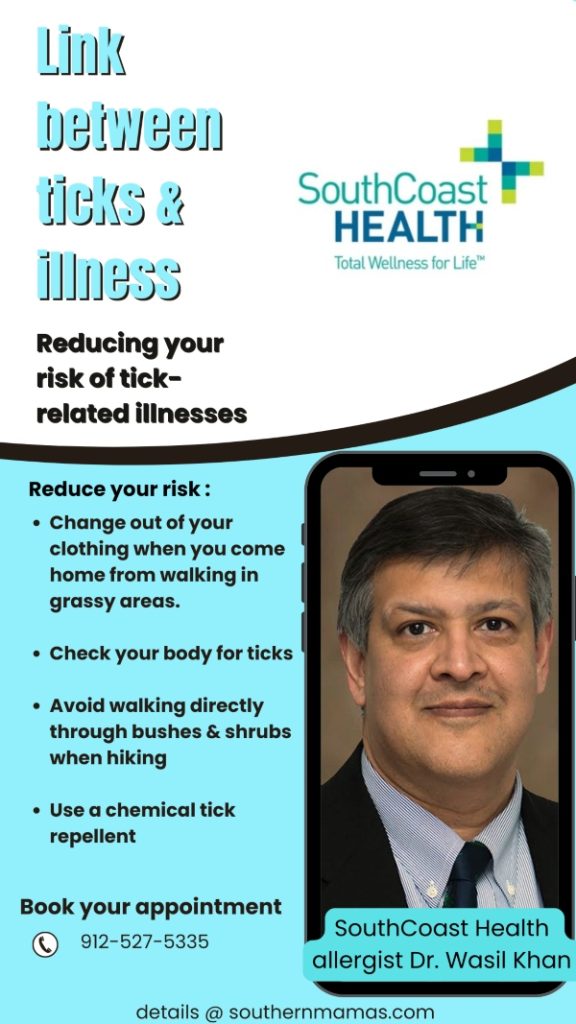
While many ticks are harmless, certain species – including wood and deer ticks – can carry germs that cause illnesses like Lyme disease and Rocky Mountain spotted fever. Recently, a new tick-related concern has emerged: alpha-gal syndrome.
SouthCoast Health Department of Allergy and Immunology is made up of experienced specialists and offers up-to-date treatment for allergic diseases. Schedule an appointment: 912-527-5335.
___________________
SouthCoast Health is a SouthernMamas.com advertiser
Posted in Health/Safety, Healthcare | Comments Off on SouthCoast Health: How to reduce your risk for tick-related illnesses
According to Coastal Care Partners Pediatrician Dr. Kelsey Alexander: “It’s smart for all parents to know in emergency situations. That’s why we consider this such an incredibly important service to offer to our community.”
The Pediatric CPR classes are 30-minute classes offered once a week at 11:45AM on Thursdays at Coastal Care Partners’ office, located at 4B Skidaway Village Walk.
These classes offer one-on-one instruction with Shelley Fields, who serves as Medical Assistant for Coastal Care Partners’ pediatric clinic and has 24 years of experience as a paramedic.
“These 30-minute classes are a great opportunity for parents, grandparents, aunts and uncles, and babysitters to learn practical tips and ask questions in a comforting environment,” said Dr. Alexander.
These classes – which are open to the public – are not certification courses.
Pre-registration is required, and interested participants are able to sign up by calling the Coastal Care Partners office @ 912.598.6312 or register online here.
Cost: $55 for members of Coastal Care Partners’ Pediatric and/or Adult Primary Care practices, and $65 for nonmembers.
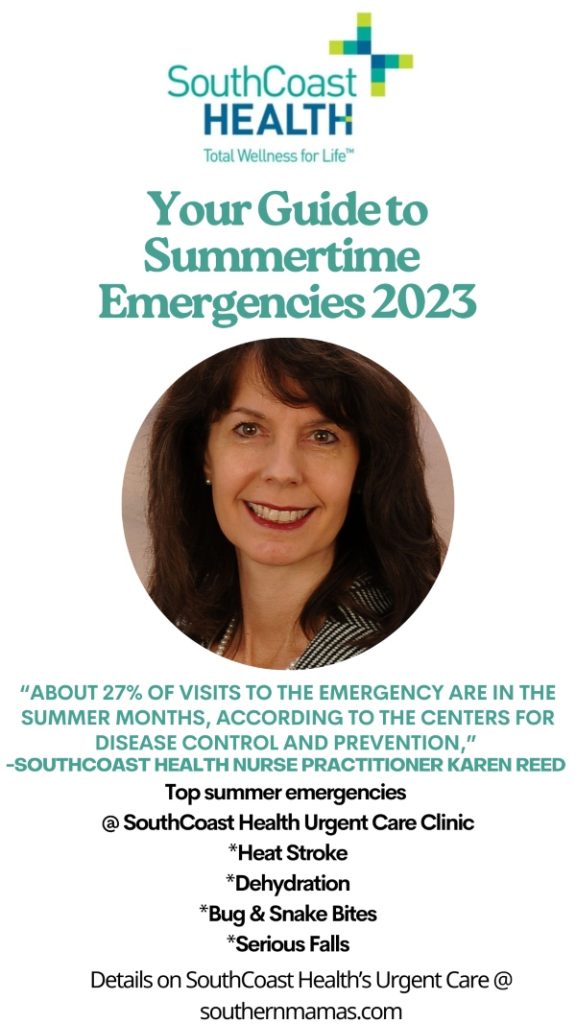
“About 27 percent of visits to the emergency are in the summer months, according to the Centers for Disease Control and Prevention,” SouthCoast Health Nurse Practitioner Karen Reed said.
Top summer emergencies include: heat stroke, dehydration, bug and snake bites, serious falls.
SouthCoast Health provides an Urgent Care clinic to the Lowcountry and Coastal Empire area of Georgia.
Find more information about summertime emergencies or SouthCoast Health’s urgent care here.
SouthCoast Health Pediatric Urgent Care Walk-In Clinics
Savannah (Pediatrics)
310 Eisenhower Dr, Bldg 16 Saturday, 9AM to Noon Sunday, 9AM to Noon
Walk-Ins Only
Richmond Hill (Pediatrics)
89 Interchange Dr, Ste B Saturday, 9AM to Noon
Walk-Ins Only
______________
SouthCoast Health is a SouthernMamas.com advertiser
Posted in Health/Safety, Healthcare | Comments Off on (Savannah/Richmond Hill Pediatric Urgent Care Clinics) SouthCoast Health Guide to Summer Emergencies
If you’re due for a doctor’s visit to prevent lapses in medication refills, turn to SouthCoast Health. With an extensive network of more than 120 providers, SouthCoast Health offers compassionate, comprehensive care for the whole family. Browse through SouthCoast Health list of physicians online or schedule an appointment by calling 912.691.3600.
Pediatric Associates of Savannah has been the local baby experts since 1971. They offer three convenient locations in Savannah to ensure your baby’s health needs are always met 365 days a year.
Pediatric Associates has offices in Savannah, the Islands and Pooler.
School’s out, and with the warm, sunny days ahead, boat rides and trips to the beach or pool are likely in your future! As you plan for your family’s summer fun, it’s important to keep water safety in mind.
As the leading cause of death in children ages 1-4 years old and the second leading cause of death for children ages 5-14, drowning accidents affect nearly 1,000 children per year, mostly between the months of May and August. So this summer, stay prepared with the below water safety tips!
Start Swim Lessons Early
Swimming is a life-saving skill that we need to teach our children and it is never too early to start. Children can start ISR (Infant Swimming Resource) swim lessons as early as six months old to learn how to float on their backs. Standard classes usually start at 18 months and teach small children how to swim to a pool ledge or short distances. Older children should learn different swim strokes to equip them for situations like fighting currents.
We do not recommend using swim floaties to teach children to swim properly. Floaties hold a child upright, encouraging them to bob up and down instead of swimming horizontally. However, families with multiple children or children that have no fear may need to use swim floaties for certain children. If your child wears swim floaties, make sure they do not take them off the entire time you are in the gated area of the pool and continue to keep them within arm’s reach.
Never Swim Alone
When kids are around water, make sure they are never left alone, including during bath time. Adults should know how to swim themselves and should never be less than an arm’s length away from kids who are not strong swimmers. For older children, make sure they always have a swimming partner. If your child is attending a camp with a pool, ensure the area is fenced and that life jackets will be provided for open water activities. While lifeguards on duty are a wonderful resource, do not rely on lifeguards alone to watch your children.
Know the Signs of Drowning & How to React
It is smart for all parents and kids to know what to do in emergency situations. Teach your children that if another child pulls them under water, even if that child cannot swim, they need to
kick that child off of them and yell for help from an adult. Limit distractions while watching your child swim because drowning is silent as opposed to what you see in the movies where kids make noise and flail their arms. Most start with their head bobbing above water, but their mouth and nose are underwater. We recommend that all parents take a CPR course in the event of an emergency, and we offer 30-minute one-on-one instruction in our office for anyone who is interested. Call 912-598-6312 for more information!
Pool Tips
If you have children or grandchildren that are not strong swimmers, it is incredibly important to install a fence around all four sides of your backyard pool. If one side of the fence is open to the house, it is just as dangerous as not having a fence. The fence should be at least four-feet high and non-climbable with a self-closing, self-locking gate. Until you can install a fence, we recommend installing locks at the top of the door and utilizing door alarms so that children cannot access the pool. When hosting families with children that are not strong swimmers, the pool should be fully enclosed, locked, and/or monitored even if children are not ‘supposed’ to be swimming. If hosting a pool party, consider hiring a lifeguard or designating “Water Watchers” to watch the pool for 15-minute increments, and avoid using large floats in the pool to improve visibility.
Open Water Tips
Open water is unpredictable and susceptible to several dangers like currents, rip tides, limited visibility, depth, and uneven surfaces. If your backyard leads to open water, consider fencing off access. Children should have Coast Guard-approved life jackets for all boat rides and recreational activities on the water. Teach children best practices, like only swimming in designated areas, always entering feet first, and avoiding cold water that can cause shock.
Protect yourself from the heat while still enjoying the perks of life in Savannah.
“When it comes to extreme summer weather, it’s important to know how and why you are vulnerable,” said SouthCoast Health primary care physician Dr. Adam Novack. “If you are aware of those vulnerabilities, like dehydration, sun burn, and fatigue, you can take steps to prevent them while still being able to spend time outdoors.”
Four tips from SouthCoast Health to help you and your family to beat the heat:
If you have any questions about health-related issues this summer, call SouthCoast Health at 912-691-3600 for help. Make an appointment with SouthCoast Health throug primary care services and ensure you and your family have a happy, healthy summer.
SouthCoast Health is a SouthernMamas.com advertiser
Latch helps those who are looking to find success with pumping when returning to work, exclusively pump, or those who just want to occasionally feed their baby pumped milk for whatever the reason!
Effingham Pediatrics is now open and seeing patients at the new location: 520 West 3rd St. in Springfield.
Join Effingham Pediatrics to celebrate the Grand Opening, meet their practitioners, and tour the new Effingham Pediatrics Center, located at the intersection of Hwy 21 & West 3rd St. in Springfield.
Latch Breastfeeding Support is a trusted name in the Savannah community. Latch has a history of working closely with families, physicians, and a variety of other health and wellness practitioners in seeking optimal outcomes for their clients.
Effingham Pediatrics is now open and seeing patients at the new location: 520 West 3rd St. in Springfield.
Join Effingham Pediatrics to celebrate the Grand Opening, meet their practitioners, and tour the new Effingham Pediatrics Center, located at the intersection of Hwy 21 & West 3rd St. in Springfield.
Harmful UV rays that can damage your skin also can negatively impact your eyes’ tissue, cornea and lenses.
UV radiation accelerates eye aging, potentially leading to cataracts, corneal damage, and macular degeneration. Each of these conditions alone can lead to vision problems, especially over time.
UV damage is avoidable when you protect your eyes by wearing sunglasses.
SouthCoast Health experts share the benefits of wearing sunglasses here.
_________________
SouthCoast Health is a SouthernMamas.com advertiser
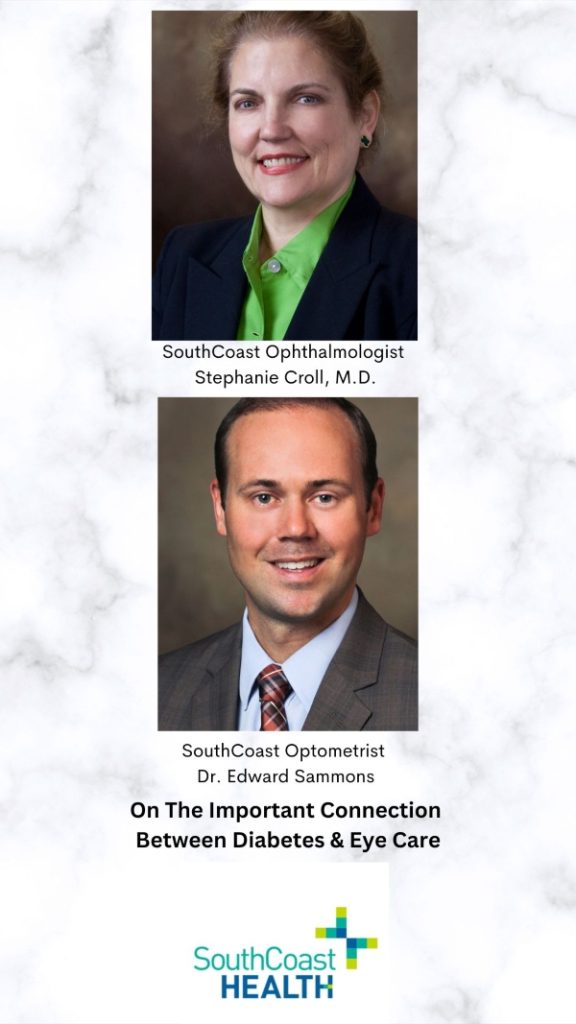
Ophthalmologist Stephanie Croll, M.D., along with Optometrist Edward Sammons, of SouthCoast Health’s Eye Care Department share here how diabetes can affect your eye health health.
If you are unsure about your need for a regular eye exam, talk with your primary care physician. Learn more about the SouthCoast Health Diabetic Self-Management Training program and Eye Care department here.
_____________
SouthCoast Health is a SouthernMamas.com advertiser
Despite the fact that mental health disorders are one of the most common diseases among children, the idea of mental health advocacy for our children is still pretty rare.
Read here how Dr. Keith Seibert and his wife, Dr. Heather Seibert, both pediatric advocates at SouthCoast Health in Richmond Hill, helped one 11-year-old girl who was struggling with mental illness including anxiety and ADHD.
Are you having trouble motivating your kids (and yourself) to get outside and spend less time in front of a screen? It’s so easy to fall into the usual routine, but why not choose one or two of these ideas to change things up this spring?
Getting a daily dose of fresh air, sunshine, and movement is great for our mental, physical, and emotional health. According to Healthychildren.org, spending time outside can help children and teens promote curiosity, creativity, and critical thinking; lower stress, depression, and anger; improve impulse control and motor development; and lower rates of obesity. All this while helping our bodies produce vitamin D to stay healthy and strong!
Gardening:
Gardening can help give your children a sense of responsibility and accomplishment, all while sparking some interest in eating different herbs, vegetables, or fruit. And you don’t need a green thumb to help get them started! Start with one or two small pots so that it is not a chore for either of you and also to make it easier to measure and track the plants’ growth. Then, try different lighting and watering as needed.
*For smaller pots, herbs (basil, parsley, rosemary, mint, cilantro) work best. Have your kids use the basil and parsley for pesto or pasta, and use rosemary on chicken or potatoes. They can also put mint and cucumber in their water and cilantro in guacamole or tacos!
*For larger pots or garden beds, try lettuce, cucumbers, bell peppers, tomatoes, strawberries, celery, green beans, okra, zucchini, and summer squash!
Other Ways to Play:
As the weather continues to warm up, there are plenty of ways to get your kids (and your entire family!) outdoors!
Stop by the park, playground, or basketball or tennis court on the way home from school. Going immediately after school prevents everyone from getting comfortable inside at home before working up the energy to get outside again. You can also bike or walk with your kids while they scooter, just don’t forget helmets!
There are also plenty of opportunities to play in the water, even if you don’t have access to a pool! Try water balloons, a sprinkler, or slip ‘n slides for water fun! You can even find reusable water balloons online to avoid picking up all the small plastic pieces afterward.
It’s important to keep in mind that you don’t have to be active the entire time you’re outdoors. Painting, writing, or reading outside can be extremely relaxing! Grab a beach chair, picnic blanket, or even a hammock to enjoy the fresh air, sunlight, and scenery.